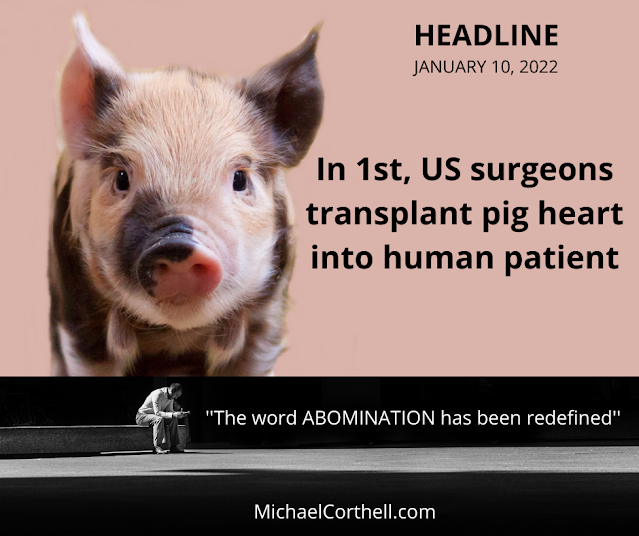
Animal Enslavement, Use and Abuse: Man Receives Heart from Genetically Altered Pig

A 57-year-old Maryland man is doing well three days after receiving a genetically modified pig heart in a first-of-its-kind transplant surgery

Xenotransplantation is any procedure that involves the transplantation, implantation or infusion into a human recipient of either (a) live cells, tissues, or organs from a nonhuman animal source, or (b) human body fluids, cells, tissues, or organs that have had ex vivo contact with live nonhuman animal cells, tissues or organs. The development of xenotransplantation is, in part, driven by the fact that the demand for human organs for clinical transplantation far exceeds the supply.

_______________

''...Oz never did give nothing to the Tin Man
That he didn't, didn't already have
And cause never was the reason for the evening
Or the tropic of Sir Galahad...''
— America

According to CNN a 57-year-old Maryland man is doing well three days after receiving a genetically modified pig heart in a first-of-its-kind transplant surgery, University of Maryland Medicine said in a news release Monday.

David Bennett had terminal heart disease, and the pig heart was "the only currently available option," according to the release. Bennett was deemed ineligible for a conventional heart transplant or an artificial heart pump after reviews of his medical records.

"It was either die or do this transplant. I want to live. I know it's a shot in the dark, but it's my last choice," Bennett said before the surgery, according to the release.

The US Food and Drug Administration granted emergency authorization for the surgery on December 31.
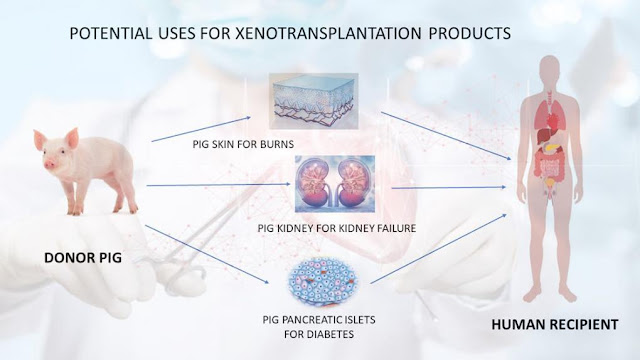
Chart describing uses for xenotransplantation

Here we are at a moral crossroads. How did we get to this point?

In 10,000 BCE humanity started down the road that has led us to this point; stealing internal organs from our fellow created beings. Stealing from individuals who are innocent, and who have their own lives that are as precious to them as our own lives are to us. What can go wrong with doing these horrific things? What has already gone wrong? Plenty.
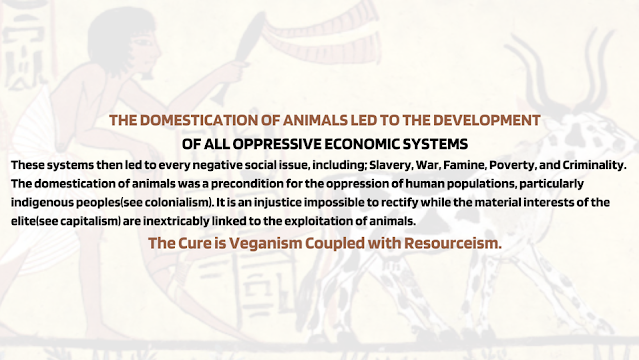
Panel showing the results of animal domestication, consequences of

Nearly all of human civilization's problems; War, Poverty, Crime, Famine, and now the Global Climate Crisis had their genesis with the subjugation and abuse of animals through their domestication.

Domestication of animals even led to human slavery colonialization. Domestication provided the blueprint and road map.

The domestication of animals also led to the concept of private land ownership and the social agreement we call 'money', as well as every market system including Capitalism. 

What is the solution? It is obvious...


If you want to know more, please join The Vegan Project. And go HERE. 

If you want to know more about veganism's supporting socio-economic system go HERE and HERE. 
________________________

The bottom line in this article is that Pigs are playful, friendly, sensitive, and intelligent animals. They’ve long been considered smarter than dogs, and the complexity of their social lives rivals those of primates. Much like people, pigs are soothed by music, love playing ball, and even enjoy getting massages. Thou shalt not kill is not a suggestion. Actions do have consequences...

''Don't Look Up!'' 


I will leave you with these sobering images of animals in hell:


Comments

Popular posts from this blog

A Comprehensive History of the New Thought Movement

  Recommended:  The Science of Mind: Complete and Unabridged The New Thought (or Higher Thought) Movement represents a fascinating and transformative chapter in the history of Western spirituality. Emerging in the 19th century, this movement has left an indelible mark on modern self-help philosophies, the culture of positive thinking, and even aspects of contemporary spiritual practices. Its influence can be seen not only in religious and philosophical circles but also in the broader social and cultural fabric of the 20th and 21st centuries. This article dives into the rich history, key figures, and enduring legacy of the  New Thought Movement , offering readers a comprehensive understanding of its origins, evolution, and impact on modern life. Origins of the New Thought Movement 19th Century Beginnings: The Cultural and Philosophical Context The New Thought Movement was born in the intellectually fertile soil of 19th-century America, a time characterized by rapid social ...

The Universal Mind: Tapping into the Source of Infinite Wisdom

  Michael Corthell Imagine a vast, infinite source of knowledge and creativity, accessible to everyone. This is the concept of the Universal Mind or Infinite Intelligence, a foundational idea in various spiritual and philosophical traditions. The Universal Mind represents a consciousness that transcends individual thoughts, offering guidance, inspiration, and solutions to those who seek it. This article introduces the concept of the Universal Mind and provides practical ways to connect with this source of wisdom. What is the Universal Mind? The Universal Mind is the idea that there exists a universal consciousness that encompasses all knowledge and creativity. Unlike our individual minds, which are limited by personal experiences and beliefs, the Universal Mind is infinite and all-knowing. It's often described as a spiritual force that underlies and connects all of existence. This concept has roots in ancient philosophies, religious texts, and the New Thought movement, where figure...

The Truest Form of Wealth: The Philosophy of Resourceism

  Golden threads of light weave across a living Earth, symbolizing the flow of shared consciousness and the harmony of all life. Resourceism envisions this balance, a world where connection, compassion, and cooperation form the true wealth of humanity. Redefining Wealth in a Resource-Based World From ownership to stewardship For most of human history, wealth has been defined by accumulation: the more we gather, own, and control, the wealthier we are said to be. But this model has brought us to a breaking point. Inequality widens. The planet strains. Billions go without while a few hold more than they can ever use. Resourceism offers another way forward. It asks us to measure prosperity not by ownership, but by access, stewardship, and contribution. It is both a philosophy and a system, grounded in fairness, compassion, and the understanding that every resource on Earth belongs to all of us. Wealth, in its truest sense, is not a personal trophy but a shared inheritance. And the mea...